
ETHAN JOSHUA
On Art, Identity, and Melanesian Memory
. . . . .
. . . . .
Ethan Joshua is a Melanesian artist and writer shaped by a childhood of vivid imagination and a heritage woven from iTaukei‑Fijian, South Chinese, and Scottish‑English roots. Born on Dharug Country, he carries the Islands in his eyes—the colours, the elders’ stories, the patterns of home—and channels them into art that listens to history, speaks to Blackness, and reaches for unity in a world that forgets it.
Ethan’s creative life began long before he had the words to describe it. He remembers being four years old, hands covered in paint, pressing colour onto a preschool canvas with the instinctive joy of a child discovering a new language. Cartoons like Steven Universe and Pokémon fed his imagination, offering him a first doorway into storytelling — a place where fantasy, emotion, and identity could coexist freely.
But his relationship to culture was more complex. Growing up mixed‑race in Australia meant navigating a layered, sometimes fragmented sense of self. His words:
“I’ve grown up with a complicated understanding of my cultural identity… but it’s shown me that strength comes through embracing all of yourself, and all of the things that you inherited.”
His heritage — iTaukei‑Fijian, South Chinese, Scottish‑English — is not a simple lineage but a constellation. And Melanesia, in particular, became a region dear to his heart. Its people, its histories, its spiritual depth offered him a grounding, a sense of belonging that transcended geography.
“Our people are so diverse and full of love… it’s a love I’ve had to learn to embody, and it rests within everything I do — especially art.”
This love, this complexity, is the foundation of his creative practice.
Origins & Identity
Ethan’s work is deeply political — not in the sense of slogans, but in the way memory, resistance, and identity intertwine. His recent piece draws inspiration from Barbara Jones‑Hogu, a central figure in the Black Arts Movement and AfriCOBRA. For Ethan, her work is not only a cornerstone of Black American history, but a reminder of how global Black movements have shaped liberation struggles everywhere, including in Melanesia.
He reflects:
“We tend to neglect the influence of Black Power politics in Melanesian history, but it was foundational within our own decolonisation efforts.”
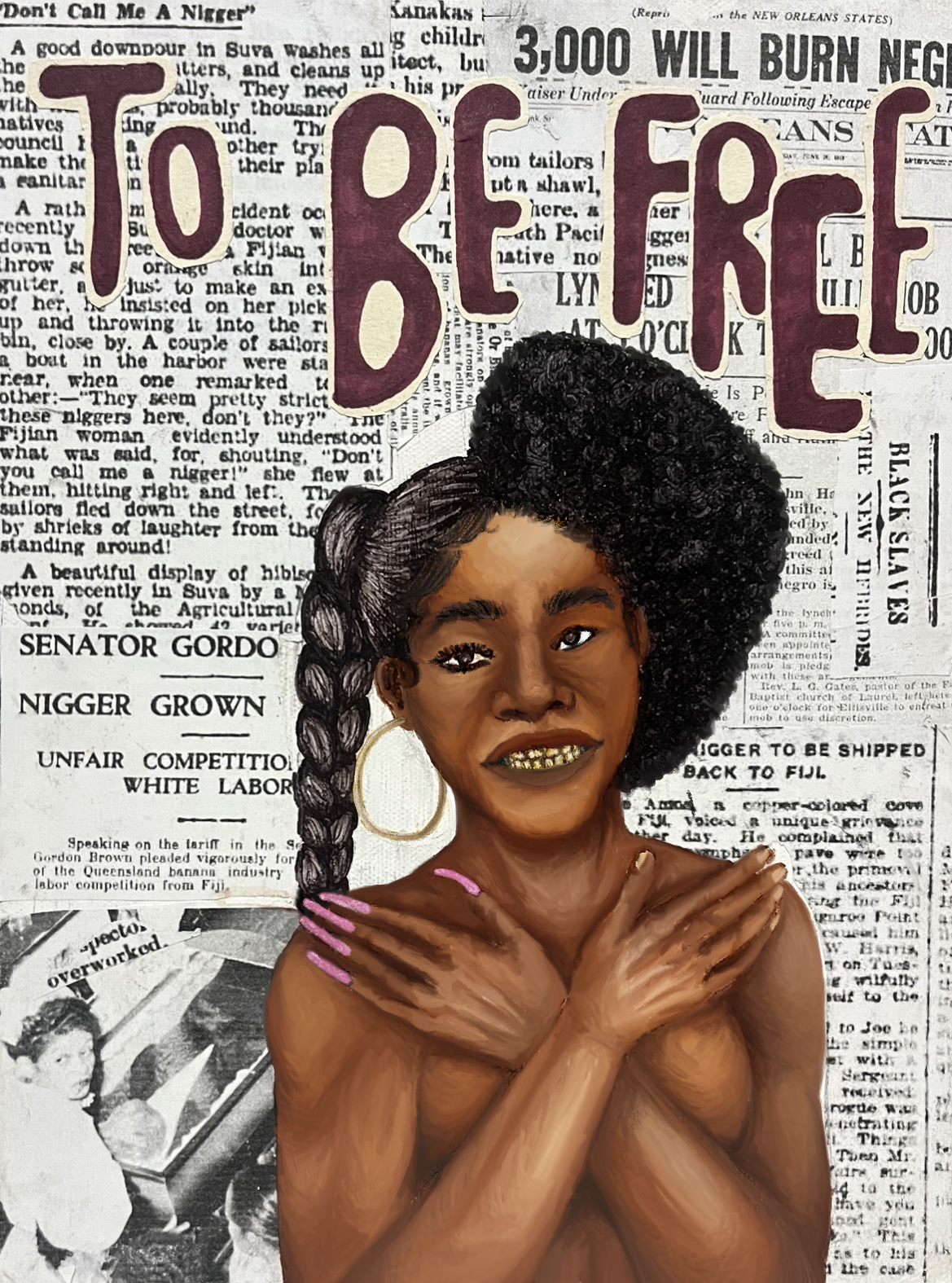
Jones‑Hogu’s piece To Be Free (TCB) — Take Care of Business — became a catalyst for Ethan’s own reinterpretation. The original artwork bursts with colour and urgency, calling for unity and action within the Black American community. Ethan recontextualises this message for the Pacific, focusing on the present moment — one he describes as “less vibrant, and sometimes less hopeful.”
“Unity is a lost art… those in power have been nearly successful in dividing people — White people, Black people, Pasifika people, even within our own diasporas.”
In his version, the words To Be Free do not sit within the silhouette of the woman, as in Jones‑Hogu’s piece. Instead, they hover above and in front of historical articles — reminders of unfinished business in the Pacific, of histories that still shape the present, of political realities that cannot be ignored.
These articles are not meant to shame or depress. They are placed deliberately, as markers of memory:
“They remind us of a past we cannot go back to, and of a history that is not as far away as we’d like to think.”
Art as Politics
Ethan’s cultural identity is not an aesthetic reference — it is a lived archive. The Islands form the backdrop of his artistic consciousness: the food, the music, the elders’ conversations, the patterns and motifs found in homes and market stalls. These sensory memories shape the way he sees the world.
“My heritage, especially my Melanesian heritage, has been a great inspiration… it led me down rabbit holes of historical events and conflicts that I’m able to connect to on a deeper level.”
Being Melanesian also means identifying with Blackness. Ethan feels a responsibility to understand global Black experiences and to give them space within his work.
“They are equally deserving of attention, and too often are they overlooked or downplayed.”
His art becomes a bridge — between Oceania and the diaspora, between personal memory and collective struggle, between the past and the future.
Melanesian Memory & Blackness
For Ethan, art is representation — but also reclamation. He speaks of how Western standards have long overshadowed Indigenous artforms, disconnecting communities from their own storytelling traditions.
“When Western culture became the dominant standard… we were taught to prioritise Western styles of art and neglect the diversity of things produced in our own cultures.”
This disconnection is not neutral. It erodes memory, identity, and the ability to communicate ancestral knowledge. Art, for Ethan, becomes a corrective lens — a frame built by Pasifika people themselves.
“If we make the frame(work) and give them the lens, then they can understand who we are and how we want to be perceived.”
Without this reclamation, Western media will continue to portray the Pacific as vulnerable, conflict‑ridden, or unimportant — narratives that serve political convenience rather than truth.
“We must remember and carry on the artistic legacy of our islands to show that we are here, that we are strong, and that we are not going anywhere.”
Representation & Creative Legacy
Ethan’s creative practice extends beyond visual art. He plans to write short stories, poems, and articles — all shared on his Substack, A.M.A. Connect, a passion project inspired by Black-American creators engaging with Melanesia and by the growing presence of Black-Australians in media.
He continues to explore identity, politics, and memory through multiple mediums, building a body of work that is both personal and political, intimate and expansive.
You can find him on Instagram and TikTok under @ej.vasu, and follow his writing on A.M.A. Connect.
Looking Forward